Collaboration With TCU Students Delivers Oyster Monitoring System
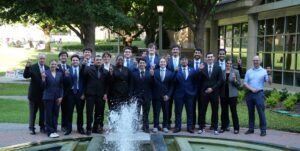
When Texas Christian University engineering students received their senior design assignment for 2025-26, many were surprised by the challenge ahead. Though trained primarily in mechanical or electrical engineering, they were tasked with creating a tool to monitor oysters and surrounding water conditions. They would have to apply traditional engineering principles to real-world environmental science challenges.
Working with Freese and Nichols mentors and a $10,000 Research and Development grant from the company, the TCU Senior Design Class delivered a system that enables the firm’s Environmental Science team to monitor oyster behavior and water conditions in real time.
The system, which the students named Shuck Dynasty, will be used to support ongoing environmental research and oyster restoration efforts. It is designed to help our environmental scientists better understand oyster behavior and surrounding water conditions over extended periods.
Demonstrating how to bridge engineering disciplines
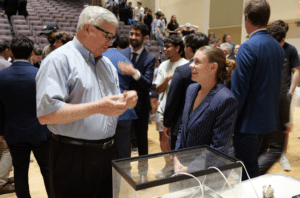
The project is the latest produced through an ongoing relationship between Freese and Nichols and TCU’s engineering
program. This year’s challenge was brought to Electrical Engineer Dan Koss, Mechanical Engineer Matt Waskowski and Environmental Scientist David Buzan by Daniel Hammond when he was an environmental scientist in the Tampa office.
Ecosystem restoration has never been more critical, and oysters play a key role in maintaining healthy coastal environments. They protect shorelines, improve water quality and create habitats that support marine life. Freese and Nichols’ coastal team has helped multiple clients with integrating oysters into shoreline protections.
Dan, Matt, David and Daniel coached the students across two semesters, offering practical insight, encouragement and guidance throughout the design and testing process. Involving the students in real design decisions and research challenges helped them prepare for engineering careers by growing their skills and confidence, practicing collaboration and expanding the application of their training.
Unlike most internships with specific tasks and solutions, this project didn’t have one right answer,” said Anna Tucci, Senior Design Class Team Lead. “Working through different approaches strengthened our technical skills and made us feel prepared to enter the workforce.
The Process:
Setting and executing goals
The team of 18 senior students had two semesters to conduct research and create their design. The team set two tiers of goals:
Tier 1 (Primary Goals)
-
Periodic maintenance should not be required more often than every two weeks.
-
The system must hold up for long deployments between significant maintenance.
Tier 2 (Additional Goals)
-
Periodic maintenance should not be required more often than every six weeks.
-
The sensor network can expand to multiple cities along the Gulf and Atlantic coasts.
-
The system can provide data to statistically estimate the quantity of water filtered by the oysters.
Developing the system
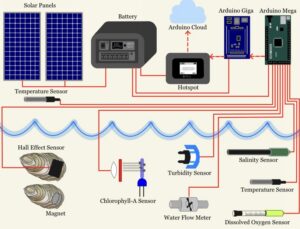
The Valve Gape team created a design that used hall effect sensors and magnets that were placed on the oysters to determine when they open and close, monitoring and recording their feeding status. The system is supported by a built-in calibration system with biweekly recalibration.
The Water Conditions team designed seven sensors to monitor and record tide and water conditions, temperature, salinity, dissolved oxygen, air temperature and chlorophyll a concentrations.
The Communications team designed protective housing for the battery and solar panels that power continuous cloud connectivity and data collection. The system transmits information to a cloud-based dashboard that displays oyster data every 60 seconds and water condition data every 15 minutes.
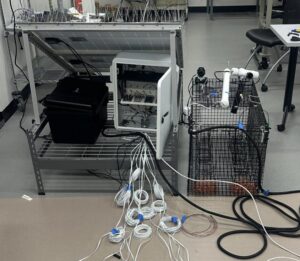
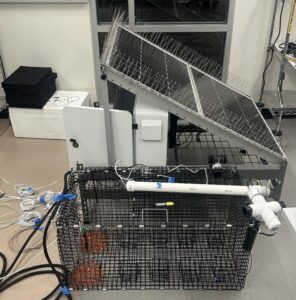
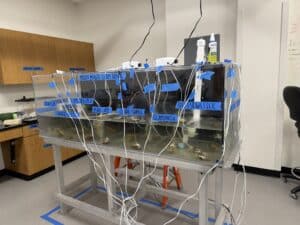
The images below show the final system design (left and center), while the image on the right highlights the tank used by the students to monitor oyster activity and test their system for data collection.