

Award-Winning Water Expansion Powers Sherman’s Semiconductor Boom

The City of Sherman Water Infrastructure Expansion project was named 2025 Public Works Project of the Year in the Environmental (Over $75 Million) category by the Texas chapter of APWA.
Located 75 miles north of Dallas-Fort Worth, the City of Sherman, Texas, faced a major water challenge. Its aging system was quickly outpaced by industrial growth following announcements of silicon chip manufacturing expansion in the area. This industrial surge, coupled with rising housing demand, is expected to triple the community’s water needs by 2048.
Sherman urgently needed expanded, adaptable water and wastewater infrastructure to support this industrial boom while maintaining service for existing residents. Freese and Nichols partnered with the City to address these challenges through a comprehensive water and wastewater master plan, as well as the design and construction of a 16-mile water transmission pipeline.
Scaling for a Booming Future

Sherman had been developing an updated water and wastewater master plan based on a modest 1.4% growth rate over the past decade and expectations that several major industrial users would soon leave the area. Shortly before the master plan was finalized, two semiconductor manufacturers, Texas Instruments and GlobalWafers America, announced plans to construct two new large manufacturing facilities in the area. The City had to quickly reassess the anticipated water demands and adjust its recommendations.
Sherman now faced a threefold challenge: surging water needs, immediate operational impacts and inherent system limitations. Every facet of the system would require improvement to meet the new demands:
-
Increased raw water supply at Lake Texoma
-
Increased treatment capacity of the water treatment plant
-
Added capacity within the high service pump station at the treatment plant
-
A new, large transmission line to help convey flows to the south of the City
Based on the new demands, more than $400 million of capital improvements were recommended for the water system.
To help the City meet this challenge, they collaborated with Freese and Nichols on:
-
Master Planning: Crafting a water and wastewater roadmap using SCADA data and flow monitoring to model system needs across the next 5, 10 and 25 years.
-
Easement Coordination: Facilitating property access by identifying priority parcels and streamlining acquisition to support tunneling alignments and site clearing for upcoming infrastructure phases.
-
Early Procurement: Preparing and releasing a targeted materials package at 60% design completion to support accelerated construction timelines, enabling advance ordering of long-lead items and minimizing schedule risks.
-
Industrial Flexibility: Responding to shifting industrial requirements by conducting real-time system reanalysis and strategically rebidding materials, maintaining construction momentum and alignment with evolving demand.
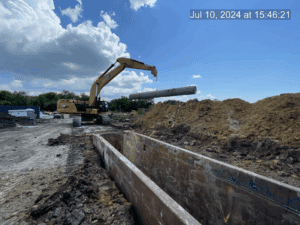
A dedicated land acquisition team partnered closely with City leaders to streamline easement negotiations and keep things moving in step with construction phases. Thanks to this teamwork and consistent coordination, the project stayed on schedule over its three-year timeline. As a result, the critical Shepherd Drive segment of the new pipeline was completed just in time to support the opening of Texas Instruments’ facility.
Innovation and Sustainability in Action
Sherman’s expansion wasn’t just about capacity; it was about efficiency and foresight. Key innovations included:
-
CMAR Delivery for Agility: The City chose a Construction Manager at Risk (CMAR) delivery method, which gave the team the flexibility to make decisions quickly and bring the contractor on board early. This approach opened the door for value engineering, constructability reviews and early material purchases, helping the team secure a guaranteed maximum price and reduce budget risks in the face of unpredictable material costs.
-
Adaptive Design for Shifting Demands: When industrial demand projections tripled, the team reanalyzed the system, confirming the existing infrastructure could handle current needs while prioritizing the pipeline’s critical segments. This adaptability saved costs and maintained the schedule.
-
Material Innovation: A 2,500-foot horizontal directional drill under a railroad and two creeks faced delays due to steel pipe shortages. The team pivoted to high-density polyethylene (HDPE) pipe and negotiated a non-standard railroad crossing agreement, saving the City money while staying on schedule.
-
Phased Construction and Easement Strategy: The team phased topographic surveys and easement acquisitions to start work on secured segments while refining others, buffering against weather and supply chain delays.
-
Sustainable Practices: The Lake Texoma Pump Station reused existing equipment, reducing new construction needs. The pipeline’s easement was designed for future expansion, and articulated concrete blocks stabilized erosion-prone areas, enhancing environmental resilience.

Community and Economic Impact
The infrastructure expansion brought long-term benefits to the Sherman community:
-
Enhanced Water Capacity: The 16-mile, 36-inch pipeline connects the Lake Texoma Pump Station to southern industrial sites, supporting a projected 65.5 MGD demand by 2048. The interconnections allow the new system to be integrated in phases, maintaining reliable service for both current and future users.
-
Uninterrupted Service: Proactive scheduling kept water flowing for residents during concurrent construction projects.
-
Cost and Schedule Management: Strategic material rebidding, use of HDPE pipe and early easement acquisition saved $2 million in construction costs. The team navigated supply chain challenges, delivering the project within budget and meeting critical deadlines.
-
Economic Growth Enablement: The pipeline’s timely completion supported the semiconductor manufacturing facility openings, positioning Sherman as a regional industrial hub and driving economic development.

By combining adaptive design with strong collaboration, the City of Sherman successfully modernized its aging, capacity-limited system into a future-ready infrastructure that supports ongoing industrial growth and delivers reliable water service to the community.
Freese and Nichols’ integrated approach helped deliver the essential infrastructure needed to support the City’s evolution into a tech-focused economic hub. The water and wastewater master plan offered a scalable roadmap for growth, while the new pipeline addressed both immediate needs and long-term demand. Completed under tight schedules and complex conditions, these efforts highlight the City’s commitment to sustaining its growth while continuing to deliver reliable, high-quality service.