

Forward-thinking Fort Benning PFAS Study Honored by ACEC Georgia
To protect the health and safety of some 100,000 soldiers, family members, veterans and civilians who use the U.S. Army’s Fort Benning in Georgia, Columbus Water Works (CWW) undertook a cutting-edge analysis for removing harmful PFAS chemicals and other contaminants from the drinking water system.

Freese and Nichols helped CWW meet their forward-thinking goals by completing an extensive pilot study of proven and emerging technologies to pinpoint effective methods for clearing PFAS and secondary contaminants. By determining the most successful and affordable solutions, the team guided CWW on safeguarding the water at one of the nation’s largest military training facilities and home of the Army Ranger School.
The study, which also provides insights on tackling PFAS for utilities across the nation, received an Honor Award from the American Council of Engineering Companies of Georgia in the Special Projects category of their 2026 Engineering Excellence Awards.
PFAS research with practical applications
Removing PFAS from drinking water has become a national imperative, especially as the potential health dangers from these ubiquitous and persistent chemicals become clearer. As utilities across the United States develop plans for meeting new federal PFAS limits for drinking water, Columbus Water Works has taken a leading research role. This PFAS pilot study provided a promising opportunity to conduct large-scale research on emerging technologies for removing vexing pollutants.
The Freese and Nichols team of treatment and transmission-utilities engineers applied their PFAS expertise to help achieve Columbus Water Works’ objectives and more, including:
-
Clarifying a path to cleaner, safer water for the Fort Benning population, which also helps assure the public of CWW’s commitment to public health
-
Identifying effective, affordable solution options that Columbus Water Works can also implement at their larger North Columbus Water Treatment Plant
-
Providing new insights into technologies for removing contaminants such as disinfection by-products, pharmaceuticals and MIB/Geosmin
The study also shines a spotlight on the broader value of new and robust data about clean-water technologies: Treatment manufacturers, engineering consultants and regulators have shown interest in exploring the findings.
Comprehensive sampling, analysis and evaluation
The process involved collecting between 100 and 500 water samples every Tuesday for six months, then sending them for lab analysis — a total of 10,500 samples from 18 different sites.
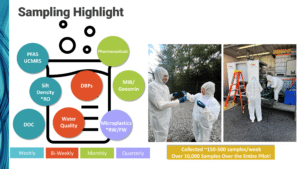
To also prepare for the next wave of potential regulations, CWW asked the team to go beyond PFAS removal to explore how well each method would eliminate disinfection by-products, dissolved organic carbon, total organic carbon, MIB/Geosmin and pharmaceuticals. The utility also showed foresight in taking the opportunity to identify microplastics’ presence in their existing raw and finished water and determine whether the existing treatment process could remove those microplastics, which are substances of increasing public concern because of their health risks. This produced valuable data — not available elsewhere — for CWW’s long-range planning.
Because the science around tackling PFAS continues to evolve, evaluating available and emerging technologies required taking a comprehensive approach and analyzing the data in light of the Fort Benning plant’s unique characteristics.
The plant pumps water from the Chattahoochee River and has been using conventional treatment followed by a microfiltration system in producing up to 8 million gallons a day of treated water. But PFAS concentrations in the plant’s raw water have exceeded limits set by the U.S. Environmental Protection Agency for two types of PFAS commonly found in drinking water: PFOA (perfluorooctanoic acid) and PFOS (perfluorooctane sulfonic acid).
To balance treatment options based on performance, reliability and cost, the team weighed multiple factors, including: capital and operations/maintenance costs; scalability; ease of operations; and management of residuals remaining from the PFAS-removal treatment process.
A wealth of data produced
The study examined the benefits and drawbacks of using proven PFAS removal technologies when applied at the Fort Benning Water Treatment Plant:
-
granular activated carbon (GAC)
-
ion exchange (IX)
-
GAC combined with IX in series
-
reverse osmosis (RO)
The team also examined the performance of emerging technologies and combinations of approaches:
-
novel media (modified clay)
-
novel media combined with GAC in series
-
ceramic membrane filtration with an active powdered activated carbon cake layer
-
RO concentrate reject treatment with GAC
-
GAC combined with IX in series
-
a foam fractionization system followed by UV destruction
Bonus finding valuable for pretreatment programs
The study revealed unexpected information that’s critical for utilities with pretreatment programs, which are common in Georgia.
A water treatment plant pretreatment program applies oxidants such as chlorine dioxide or chlorine early in the treatment process, converting dissolved metals such as iron and manganese into solid forms that can be easier to remove downstream. The team discovered that some of the filtering media tested actually increased the concentrations of disinfection byproducts in water that had been pretreated with chlorine.
Utilities with pretreatment programs need to know about this because using the wrong media could interfere with a treatment plant’s functioning and ability to meet regulatory limits on disinfection by-products.