

Lead and Copper Rule Compliance Countdown: Strategic Planning for 2027 Deadline

Julie Huerta
Regulatory Compliance Specialist

Koby Boman
Water/Wastewater Treatment Engineer

Radha Jagwani
Water/Wastewater Planning Engineer
The federal Lead and Copper Rule Improvements (LCRI), finalized in October 2024, represent the most comprehensive effort to date to eliminate lead exposure from drinking water across the United States. While utilities have until Nov. 1, 2027, to comply with some provisions, other requirements are already in effect. Planning and acting now will smooth the transition to that 2027 deadline.
What should utilities be doing now? 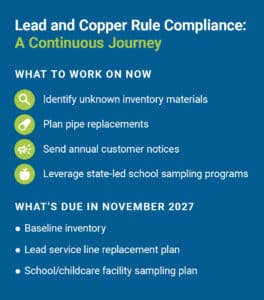
- Continue updating your service line inventory: Keep adding the most accurate and complete data. An updated inventory is due to your state by Nov. 1, 2027.
- Give customers annual notices on service line material: Each year, customers must be told if they are served by lead, “galvanized requiring replacement” (GRR) or “unknown material” service lines using the most recent inventory data. If your system submits an updated inventory, notices to customers must be sent within 30 days after the submission. Some states require notices by Dec. 31 each calendar year.
- Inform new customers about their service lines: New customers must be told about service line material when they open accounts at addresses with lead, GRR or unknown service line materials.
- Certify that notifications were provided: By July 1 of each year, systems must certify to their state that they met the notification deadline.
- Plan for school/childcare facility sampling: Starting Nov. 1, 2027, water at school and childcare facilities built before 2014 must be sampled and tested at a rate of 20% per year for five years until all have been sampled. Because this will require significant ongoing coordination with the facilities, starting to sample before the compliance date is a good idea.
What is due Nov. 1, 2027?
Submit to your state these items:
- Baseline Inventory: This should include lines with identified lead and GRR, along with unknown material. This pool will be used to calculate the number of lines that must be replaced per year. The baseline inventory must be made publicly accessible (ideally online).
- Lead Service Line Replacement Plan: This should include a strategy for identifying unknown material service lines, including field procedures, communications, prioritization of replacements and funding.
- School/Childcare Facility Sampling Plan: This should reflect a program to sample facilities built before 2014 at a rate of 20% per year for five years until they have all been sampled.
What else should utilities keep in mind?
These aspects of the rule have varying deadlines:
- Updated Public Outreach: You must notify customers served by lead, GRR and unknown material service lines and provide them with filters when their line is physically disturbed or their water service is interrupted.
- Updated Monitoring Plan: You must update monitoring plans with new procedures and sample sites before the first lead and copper monitoring period that begins after Nov. 1, 2027.
- Lead Service Line Replacement: After submitting your baseline inventory, replacement of lead, GRR and unknown service lines must follow the Environmental Protection Agency’s replacement formula (about 10% of the remaining inventory per year).
How Freese and Nichols Can Help
Freese and Nichols’ water treatment and asset management teams have the tools and expertise to help utilities with their continuing efforts to comply with major Lead and Copper Rule Improvements requirements. We can assist with:
- Support for reducing unknown service line materials using the following methods:
- Program support for field inspections
- Desktop analysis and records review
- Predictive modeling efforts (depending on state standards)
- Support for meeting new monitoring requirements
- Development of processes and procedures to address communication and replacement requirements
- Development of a strategy for lead service line replacements
- Help with addressing gaps in resources needed to meet the compliance deadline
For support, contact: Julie Huerta, julie.huerta@freese.com, or Koby Boman, koby.boman@freese.com.
Julie Huerta directs Freese and Nichols’ program to help clients meet new federal drinking water standards. She is based in Houston, Texas.
Koby Boman, PE, is a Water/Wastewater Treatment Engineer focusing on regulatory compliance, based in Houston.
Radha Jagwani, EIT, is a Water/Wastewater Planning Engineer based in Atlanta, Georgia.