Stormwater Regulation in North Carolina: A Guide to MS4 and Beyond
Stormwater runoff transports pollutants from roadways, parking lots, construction sites, and industrial facilities, threatening water quality across North Carolina. To help protect its water, the state’s Stormwater Program is administered by the Division of Energy, Mineral, and Land Resources (DEMLR) under the Department of Environmental Quality (DEQ). It combines federal mandates like those found in the National Pollutant Discharge Elimination System (NPDES), state rules like those found in MS4 permitting, and watershed-specific criteria to protect surface waters. Below is a breakdown of some of the regulations and permitting requirements that are most important for municipal, construction and industrial stakeholders.
Municipal Separate Storm Sewer System (MS4) Permitting
What is MS4?
Commonly referred to as “designated” or “tipped MS4 areas,” an MS4 is a “municipal separate storm sewer system,” or a storm sewer system owned by a public entity like a city, county or public agency. A storm sewer system includes: ditches, curbs, gutters, pipes and similar means of conveying runoff that discharge directly to creeks, rivers, or lakes without going through a wastewater collection system.
MS4 Program Requirements
Each MS4 permittee is required to develop a Stormwater Management Program (SWMP) and Total Maximum Daily Load (TMDL) compliance, routine inspections, structural control measure (SCM) maintenance, and annual reporting. The SWMP should include:
- Enforceable Best Management Practices (BMPs) and associated measurable goals for implementation
- The following Minimum Control Measures (MCMs):
- Public Education and Outreach
- Public Participation and Involvement
- Illicit Discharge Detection and Elimination
- Construction Site Runoff Controls
- Post-Construction Site Runoff Controls, such as SCMs
- Pollution Prevention and Good Housekeeping
a. Municipal “Industrial” Facilities
b. Spill response
c. MS4/Stormwater Control Measures Operation and Maintenance
d. Pesticide, herbicide, and fertilizer management
e. Vehicle and equipment maintenance
f. Pavement management
How are MS4 permittees identified?
To authorize the discharge of stormwater, the North Carolina DEQ permits approximately 122 MS4 entities under Phases I and II. Each year, the DEQ must audit 20% of MS4 permittees to verify compliance with permit terms. MS4 permittees are identified using the following categories:
- Phase I MS4 – Federal Designation
- Phase II MS4 – Federal/State Designation
- Post-Construction Programs
a. Tipped MS4 Counties
b. Coastal Counties
c. Outstanding Resource Waters/High Quality Waters
d. Goose Creek Stormwater
e. Local Watershed Protection Programs
Phase I MS4 Overview
In 1990, the EPA issued the Phase I MS4 regulation requiring medium and large cities and certain counties with a population of 100,000 or more to obtain NPDES permit coverage for stormwater discharges. Initially, seven large municipalities in North Carolina were required to obtain coverage. Each Phase I MS4 is authorized to discharge stormwater from its MS4 by an individual permit.
Phase II MS4 Overview
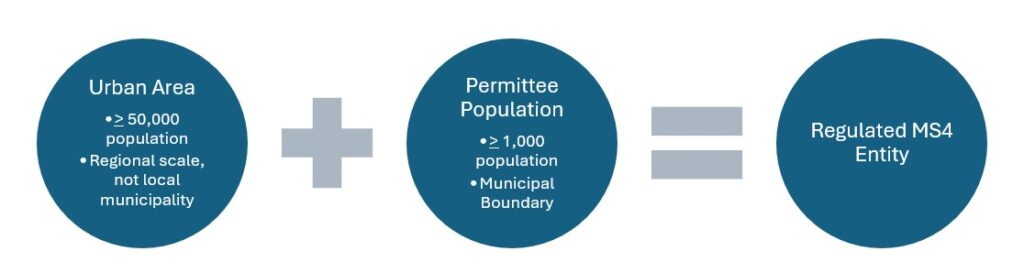
Shortly after the initiation and implementation of the Phase I MS4 regulation, the EPA developed a second phase of the MS4 permitting program to effectively protect the water of the United States from small MS4s. Phase II MS4s are identified when the urban area has a population greater than or equal to 50,000 on a regional scale (not a local municipality), and the permittee population is greater than or equal to 1,000 and has a municipal boundary.
The 2000 census was the first to be used to identify Phase II MS4 program permittees, with the most recent permittees being identified by the 2020 census. This method also allows the Phase II MS4 program to expand to include additional permittees with every decennial census.
North Carolina DEQ also designates Phase II MS4 permittees using state designation criteria. State designation criteria include entities that are characterized as one or more of the following:
- Potential for adverse impact on water quality
- Concentrated population
- Petitioned to be regulated
- Total Maximum Daily Load (TMDL) implementation plan listing the MS4
Using the above criteria, the North Carolina DEQ is considering an additional 12 potential state-designated Phase II MS4s: Long View, Havelock, River Bend, Trent Woods, Summerfield, Pinehurst, Southern Pines, East Spencer, Spencer, Waxhaw, Weddington, and Rolesville.
Notable DEQ MS4 Resources:
- Interactive MS4 Map Viewer
- Annual Self-Assessment
- MS4 Forms & Resources
- MS4 Permittee & Permit Requirements
Post-Construction Program Requirements
North Carolina’s Post-Construction Program is implemented by a combination of DEQ and local governments and is intended to protect surface waters from the impacts of stormwater runoff after a site has been developed using state-approved Minimum Design Criteria (MDC) for all SCMs. The MDC (15A NCAC 02H .1050) set standards for all SCMs, for example, determining SCM size, site layout, extent of treatment, etc. Generally, new developments transform historically permeable ground cover into impermeable built-upon areas (BUAs). These BUAs require specific actions to be taken to control runoff quality and quantity in sensitive areas determined by the DEQ or local jurisdictions.
The program distinguishes between low-density and high-density projects. Watershed classifications also play a role in determining how stringent the requirements. Post-Construction Programs include Coastal Counties, Outstanding Resource Waters/High Quality Waters, MS4 Tipped Areas, Goose Creek Stormwater, and localized protection plans. Visit the DEQ’s Summary of Post-Construction Programs and the Post-Construction Stormwater Map for more information.
Construction Stormwater Permitting
According to the EPA, sediment is the most common pollutant in rivers, streams, lakes and reservoirs. Natural erosion does occur; however, the most concentrated sediment pollution sources are construction activities that disturb soil. North Carolina’s Construction Stormwater Program, as part of the NPDES, is used to limit sediment pollution and erosion related to land disturbing activities that disturb one acre or more of soil or are part of a larger common plan of development that disturbs a total of one acre or more of soil. This program utilizes two general permits, General Permit No. NCG010000 and General Permit No. NCG250000, to regulate sediment discharges from construction activities.
General Permit No. NCG250000 applies to all owners or operators of construction stormwater discharges associated with clearing, grading, and excavation that are not subject to the North Carolina Sedimentation Pollution Control Act of 1973 (SPCA) and are subject to the Clean Water Act. Inversely, General Permit No. NCG010000 applies to those construction stormwater discharges subject to both the Clean Water Act and the SPCA.
The SPCA was enacted to further protect North Carolina’s streams, lakes, and other surface waters from land-disturbing activities. Eligible land disturbing activity must have an approved Erosion and Sediment Control (E&SC) plan that meets all SPCA standards (e.g., disturbed soil stabilization timeframes and requires buffer zones near watercourses).
Industrial Stormwater Permitting
If left unchecked, industrial activities have the potential to introduce a multitude of pollutants to stormwater runoff. The DEQ administers the Industrial Stormwater Program in North Carolina, using a combination of individual industrial permits and 20 general industrial stormwater permits to manage stormwater discharge quality at industrial facilities. Industrial facilities must apply for coverage under the general or individual industrial permit unless the facility operations qualify for a No Exposure Certification, which applies if all industrial activities and materials are fully sheltered from rain and runoff.
General industrial stormwater permit requirements include application submission (Notice of Intent or individual permit application), Stormwater Pollution Prevention Plan (SWPPP) development and implementation, outfall monitoring/testing, recordkeeping, inspections, control measure maintenance, and discharge monitoring reporting.
How Freese and Nichols can help with compliance:
Our technical experts regularly provide MS4, Construction Stormwater, and Industrial Stormwater consulting services to meet the EPA’s NPDES stormwater quality protection mandates.
Since 1894, Freese and Nichols has supported municipalities in meeting their long-term and emergency needs, including bringing multiple levels of expertise to stormwater permitting and implementation:
Permitting Support
- Permit renewals and new authorizations.
- Stormwater Management Program development.
- Construction Stormwater Pollution Prevention Plan development and implementation.
- Industrial Stormwater Pollution Prevention Plan development and implementation.
Compliance and Regulatory Coordination
- Regulatory agency coordination for renewals, inspections, audits, and compliance support.
- Report assistance includes annual reporting and discharge monitoring reports.
- Data and recordkeeping management for documentation compliance, integration with asset management and/or work order systems.
Operations and Inspections
- Illicit Discharge Detection and Elimination (IDDE) inspections.
- Construction SWPPP plan reviews and inspections
- Structural control measure inspections.
- Municipal facility inspections and audits.
- Storm sewer system mapping, inventory, and condition assessment
Standard Procedures and Training
- Standard operating procedures and checklist development
- Public education and outreach, including websites, fact sheets and in-person engagements.
To learn more, contact your Freese and Nichols client representative or any of our North Carolina permitting compliance team: Phillip Todd, Blair Hinkle or Jason Steele.