


Dustin Pope
Program Manager
Dustin Pope says he likes to juggle chaos. He likes to take the pieces of a vast puzzle and put them together. That’s how he describes Program Management and his role at Freese and Nichols since 2018. But it isn’t because he thrives in dysfunction or enjoys solving the odd problem: it’s all about the impact.
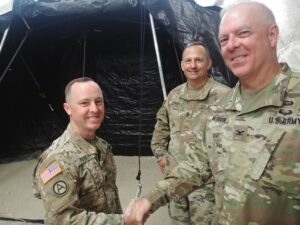
Before coming to Freese, Dustin spent eight years on active duty in the U.S. Army, stationed at Fort Stewart, Georgia, Fort Bragg, North Carolina, Fort Leonard Wood, Missouri, and Fort Hood, Texas. He spent more than seven years in the Army Reserve based at Ellington Joint Air Base, Texas. Now a Major in the Reserve, he serves as a combat engineer/staff officer.
When transitioning from active duty to his civilian career, Dustin sought a role that would allow him to keep the sense of service he had developed in the Army. He said he sees taking on these complex problems as a way to continue his service for our clients and ultimately our communities.
“When you finish one of these projects and see what it brings to the community, it’s the most satisfying part of the job,” Dustin said.
Read on to learn more about his story:
What attracted you to Freese and Nichols?
I joined Freese and Nichols in 2018 after leaving active duty with the U.S. Army. A couple of people I met in the Dallas–Fort Worth and Houston areas who worked at Freese and Nichols introduced me to the firm. After that introduction, I was sold on the company’s mission, values and the culture that Freese and Nichols represents.
There were key components I was looking for. From a technical perspective, engineering was what I did in the Army. But beyond that, I valued continuous learning — something I wanted wherever I worked. I also wanted to be part of a team. I enjoy individual sports, but professionally, I’m a team player. Freese and Nichols offered all of that and checked every box for me.
How would you describe your work?
I’m a super project manager, though even program management can be tough to define. At its core, it’s about taking a complex problem set and providing an adaptable, scalable solution to address it. There are a few key components. Many of our programs involve medium to large teams, and we often collaborate across multiple practices: stormwater, water, wastewater, transportation. That means diving into different disciplines and teaming up with experts from each area.
To succeed, you must be a strong program manager and embrace chaos. It’s about managing complexity and solving puzzles every day.
What similarities do working at Freese and Nichols and serving in the Army share?
A sense of service, or selfless service as we called it in the Army, was one of our values. That’s something I see reflected in Freese and Nichols’ “Serve Always” value. It’s a big reason why I chose this firm. In our profession as engineers, that’s what we do at the end of the day. Yes, our clients are cities, counties, water districts and water authorities, but the end users are us, our people, our citizens, our communities.
When I started, we had about 800 employees. Now we’re close to 1,400. Even as we’ve grown, leadership makes it a point to keep that family-focused environment. For example, Brian Coltharp, our CEO, would occasionally peek his head into my office when I was in Houston. At the time, I was just a junior project manager, and he would ask, “How’s it going? How’s life? How’s work?” That’s the level of family togetherness we have at Freese and Nichols.
For veterans, there are a lot of key components that carry over from service. Continued training is one. My biggest concern coming from active duty was that I’d get tucked into a cube and left on my own. That’s not the case here. You’ll keep learning, you’ll be part of a team, and you’ll have mission, vision and values. Most importantly, you’ll have that component of selfless service.
What advice would you give to young professionals or someone transitioning out of active duty?
Don’t just think about the technical components of what you do. Those should excite you, but focus on the qualities you’re looking for in a career. Some people like working individually, others thrive as part of a team. Some love to travel, others hate it. Think about the components that make you thrive.
The technical side will come. Your company will mentor and shape you to become technically proficient. But first, think about the qualities that make you tick.
How did the Veterans Employee Resource Group get started?
We were one of the first two employee resource groups. When I first joined the Reserve after active duty, my brigade commander, who is still a mentor to me, told me about the veterans resource group at her company and the tools they provided to help other veterans. That stuck with me.
After being at Freese and Nichols for a while, I started meeting more veterans and folks currently serving in the Reserve or National Guard. I wanted to create a resource for veterans within the firm. Initially, it was just a way for veterans to connect, but it’s open to everyone. Some of our efforts include supporting initiatives like the Wounded Warrior Project, and we also provide practical resources. For example, when I first joined, I had never done a timesheet. We have an onboarding playbook for new hires, but we added resources for those coming off active duty, like translating military language into Freese and Nichols terms.
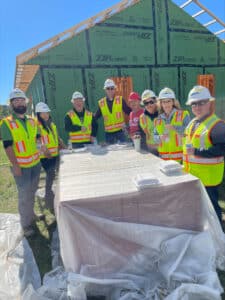
I wanted to be an advocate, and the group grew from there. The Veterans Employee Resource Group has created a sense of community and even leadership opportunities within divisions. Freese and Nichols has seven divisions, and we have local champions in each to help us connect with communities. That’s important to us. We care about more than engineering. We want to be out in our communities, helping others. We’ve supported initiatives like Habitat for Humanity, building houses for homeless veterans, and countless other events for veterans through the resource group.