

Water/Sewer Expansion Lays Groundwork for North Carolina Economic Growth
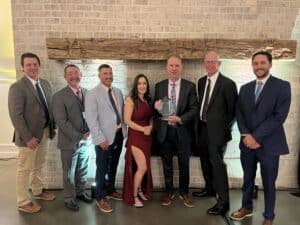
The City of Sanford’s Triangle Innovation Point (TIP) Water and Sewer Improvements project received an Honor Award in the Water & Environment category from the North Carolina chapter of ACEC at the 2025 Engineering Excellence Awards.
This project advances to the national ACEC Engineering Excellence Awards.
Facing capacity challenges due to future growth and the arrival of international business, the City of Sanford, North Carolina, undertook $141.3 million in water and sewer improvements in a comprehensive program that has paved the way for Chatham County to compete on a global stage.
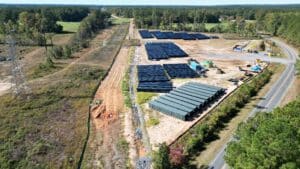
The complex project, known as Triangle Innovation Point (it previously was called Project Blue), included 25 miles of water and sewer pipelines, a new lift station and three lift station upgrades — all completed on an accelerated schedule using Construction Manager at Risk (CMAR) delivery.
One of the largest economic development projects in North Carolina’s history, TIP prepared the water and wastewater systems to meet growth demands and support recruitment of substantial projects beyond the county and the Raleigh-Durham Triangle Region.
Teamwork to complete a monumental project
The City partnered with Freese and Nichols on design, permitting, and bidding and construction assistance for the added water and sewer capacity required at TIP. This project was successfully completed across multiple phases and funded by local and state appropriations and grants.
-
Phase 1, designed and constructed within 14 months, provides water supply facilities from Chatham County to the TIP site and sewer service from the TIP site to the city’s existing wastewater system.
-
Phase 2, designed and constructed within seven months, provides new water transmission facilities from the city’s water treatment plant with parallel force mains extending from the existing Shaddox Creek Lift Station to the Big Buffalo Wastewater Treatment Plant and upgrades for additional capacity to three existing lift stations.
Completion was a team effort focused on maximizing the city’s budget, jump-starting the project through early CMAR engagement and intricately planning for the project’s more than 200 team members to expand usability across the 2,000-acre project development.
Well-planned sequencing, research and management techniques helped overcome inflation and market challenges.
Cost-effective execution on an expedited schedule
Collaborative Project Delivery: Typically, projects of this magnitude take more than three years from design to construction, but the team completed the improvements in less than half that time using the CMAR method.
Project sequencing included an innovative design and easement acquisition process that featured:
-
Phased design to prioritize the infrastructure needed for preliminary flows
-
Continuous updates to easement tracking spreadsheets for real-time status updates
-
Plat development during preliminary design
-
Consolidation of water and force mains into single-plan sheets to reduce drafting time
Cost Savings: The team engaged in extensive value engineering, design iterations and collaboration with the CMAR to land the project on budget. These efforts trimmed tens of millions of dollars from preliminary cost estimates of $170 million+. The final cost totaled $141 million, despite significant cost uncertainty at the end of the COVID-19 pandemic marked by escalated material prices and daily fluctuations.
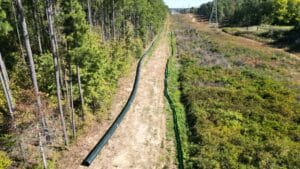
An example: Using high-density polyethylene (HDPE) pipe alongside native embedment materials saved time and money and enabled expedited material procurement and installation. This was Sanford’s first time to use HDPE, so it was necessary to help city stakeholders and system operators better understand the material’s engineering benefits.
Environmental challenges addressed
Permitting through the U.S. Army Corps of Engineers addressed complex environmental issues, including:
-
Evaluation of three regional alternatives to avoid and minimize environmental impacts to an area that encompasses a delineation of Waters of the United States
-
Habitat and presence/absence surveys for federally protected species
-
Cultural resources evaluation and coordination
-
Comprehensive impact analysis and mitigation
One of the most significant environmental benefits is the project’s ability to address PFAS (per- and polyfluoroalkyl substances) in the water system. The TIP water supply is now aligned with the Sanford water system, allowing compliance with PFAS compliance limits. TIP’s new water transmission system also is being extended to a neighboring town to replace water from its water treatment plant, which is known for record-high PFAS readings. This will bring residents safer, more reliable water.