

A Framework to Help Public Utilities Evaluate Data Center Impacts

Adam Conner
Hydrologist
Intensifying public debates over data centers might suggest these facilities are a new development, but for some time they’ve been behind much of our daily digital activity: Everyone who opens an app on their phone, joins a virtual meeting or takes a photo that gets stored in the cloud is using a data center. Businesses, government offices, hospitals, police and fire departments and schools all rely on data centers to deliver goods and provide services. Add in the rapid spread of AI tools, and the explosion in data centers is more understandable.
As more communities across the United States wrestle openly with the potential impacts of data centers on their resources and on residents’ well-being, there are important questions that water utility leaders can be asking data center developers, regardless of location.
This article will provide guidance on those questions.
But first, a look at what’s been happening, where changes are underway and what to expect next.
What are some of the unseen demands data centers put on resources?
The considerations receiving the most attention are potential strains on local water and power systems. But not all of the impacts are immediately obvious.
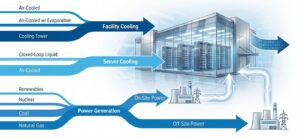
Data centers’ water needs are both direct and indirect, and the amount of water used depends on a facility’s technology. Most data centers being built today are installing water-efficient cooling technologies to keep their direct water usage low.
Often overlooked is the indirect water demand: the water needed for the process of generating electricity to power a data center. Typically, this water volume far exceeds the direct water demand. Indirect water demand can be felt at a power generation facility several counties away from a data center, or at a power plant directly adjacent to the data center (behind-the-meter) — or at locations in between.
Indirect water demand from power generation depends on the power source. One study from Texas helps illustrate this. A recent report by the Houston Area Research Council showed that if a large load demand of an additional 78 GW by 2030 all came from sources within the grid operated by the Electric Reliability Council of Texas (ERCOT), water demand to generate that additional power could increase by eight times from what is estimated to be the water demand from power generation of the data centers operational in the state today.
Texas is in a unique situation from other states because it operates its own power grid. But the state also is home to a fast-growing number of data centers — along with a large number of applications to connect to the power grid, mounting public opposition and a fluid political landscape.
How are lawmakers across the country responding?

Movement has differed depending on local and state considerations. However, there has generally been rising bipartisan concern among lawmakers at all levels about data centers’ impacts on their constituents’ health and quality of life.
Hundreds of bills have been filed in state legislatures seeking to create a framework (or improve an existing framework) for regulating data centers.
This is happening on the local level as well, where communities in a number of states have passed ordinances or other measures to restrict data center development or even ban the facilities outright.
This map shows a sampling of communities that have taken actions to limit data centers. (The list isn’t comprehensive.)
Given the water needs for power generation, where are projections of large load capacity informative?
In Texas, political, institutional, natural resource considerations and public opinion are at a confluence. Applications for large load interconnections jumped in just the six months from September 2025 to March 2026. During that period, ERCOT saw requests to add roughly 200 gigawatts (GW) by 2030.
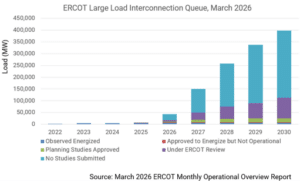
That means ERCOT is being asked to authorize as much as 400 GW on the grid by 2030 — even though it currently only accommodates a fraction of that: As of March 2026, about 5 GW of annual large load capacity were energized and operational.
In early August 2026, Gov. Greg Abbott directed ERCOT and the Public Utility Commission of Texas to pause moving any data center applications forward until the agencies conducted a comprehensive verification and audit of the projects. It’s not clear how this development might affect data centers developing their own power.
How can water utility leaders evaluate and navigate the landscape?
The following considerations provide a foundation to aid water utility leaders in making data-driven decisions.
When first approached by a data center developer, consider asking the following:
- Will your power source be behind-the-meter, from the grid, or a combination? Will there be separate water meters for power generation and facility usage?
- Will your source water be from the water utility distribution system or developed independently?
- What specific community benefits are you willing to consider?
- What type of server and facility cooling will you be using? What will be the rack density? Will you be using closed-loop cooling?
If discussions with a developer are advancing positively, consider requiring the following:
- Public reporting of water usage once the facility is in operation
- Use of alternative water supplies (brackish groundwater, municipal reuse, etc.)
- Robust community engagement led by the data center developer
- Use of closed-loop cooling
- Use of renewable energy sources
- Minimum durational commitments
How Freese and Nichols Can Help
Freese and Nichols does not design data centers, so we can bring an unbiased expert perspective to advising communities on challenges they might be facing. Freese and Nichols is helping communities across multiple states to better understand the water demands of prospective data centers and create frameworks for responsible management of the facilities based on their local needs.
Our Water Resources Planning, Water/Wastewater Planning and Urban Planning + Design teams also have developed tools to help water utilities, municipalities and counties calculate the potential water demand of a data center based on several key variables.
For more information about our Data Center Water Demand Consulting services, please contact:
- Texas: Adam Conner, adam.conner@freese.com
- Oklahoma: Jeremy Rice, jeremy.rice@freese.com
- North Carolina/South Carolina: Brian White, brian.white@freese.com
- Florida: Kendall Ryan, kendall.ryan@freese.com
- Arkansas: Jason Cocklin, jason.cocklin@freese.com
- Colorado: David Bennett, david.bennett@freese.com
- Georgia: Casey Porter, casey.porter@freese.com
- Kansas: Brian Glynn, brian.glynn@freese.com
- Louisiana: Philip Taucer, philip.taucer@freese.com
- Data Center Policy Consulting: Daniel Harrison, daniel.harrison@freese.com; Danny Wilson, danny.wilson@freese.com
Adam Conner, PMP, ENV SP, is a Hydrologist in Austin.