

Continue PFAS Compliance Planning — But Keep an Eye on EPA Actions

James Naylor
National Technical Leader, Water/Wastewater Treatment

David Jackson
Water/Wastewater Treatment Practice Leader
The Environmental Protection Agency (EPA) is moving forward on a proposal to delay a PFAS compliance deadline until 2031 — but that change isn’t final as it makes its way through the federal rulemaking process.
For water systems, that means it’s important to continue planning and executing early steps of your program to detect, monitor and, if needed, remove per- and polyfluoroalkyl substance (PFAS) contaminants.
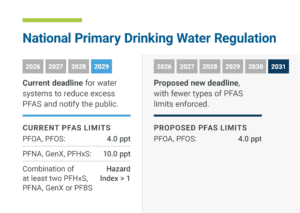
The EPA is accepting written public comment until July 20, 2026, on the latest version of the proposed PFAS compliance deadline and the proposed substances to be regulated.
If finalized, the new rules would reduce the number of substances the EPA restricted in a 2024 version of the National Primary Drinking Water Regulation. Water systems would get an extra two years to meet the limits of 4.0 parts per trillion limits on perfluorooctanoic acid (PFOA) and perfluorooctane sulfonic acid (PFOS), the only “forever chemicals” included in the latest proposal.
Even as the federal approach fluctuates, many states are adopting their own restrictions, particularly as public awareness and concern about the contaminants intensify. State rules take precedence if they’re stricter than federal requirements.
The EPA has scheduled a July 7 virtual hearing on the proposed changes, with registration required by July 1.
Here are the details of the EPA proposal announced in May.
What would be regulated?
PFOA and PFOS limits maintained at 4.0 parts per trillion (ppt): These would be the Maximum Contaminant Levels (MCLs) for perfluorooctanoic acid and perfluorooctane sulfonic acid, two types of PFAS commonly found in drinking water.
Four previous limits dropped: EPA would reconsider previously set limits on perfluorononanoic acid (PFNA), hexafluoropropylene oxide dimer acid (HFPO-DA, commonly known as GenX), perfluorohexane sulfonic acid (PFHxS), and a Hazard Index rule applying to any combination of these substances.
How would the compliance deadline change?
Compliance delayed until 2031: Water systems that exceed one or more of the limits (MCLs) would have two more years (instead of 2029) to reduce the PFAS in their water and notify the public about the violation. That would mean extra time to plan, fund and implement treatment solutions.
What should water systems be doing now?
The deadline of 2029 remains enforceable until it’s formally changed after the new round of rulemaking is completed. The broader number of regulated substances also stays in effect for now.
Water systems can plan within this evolving landscape by continuing their efforts while remaining flexible.
While your plans depend on your local and state situation, these guidelines can help:
- Compliance Plan: Develop a step-by-step action plan that outlines your options, funding sources and steps for pivoting if results or regulatory expectations change. Tie this to clear guidance materials summarizing EPA and state requirements and deadlines for monitoring and compliance.
- Monitoring/pilot testing: Finish these activities to identify optimal PFOA/PFOS treatment for your system.
- Capital spending: Review and adjust your plans for PFAS testing, monitoring and treatment upgrades. Build in enough time because installing treatment systems can take four to five years of planning, design and construction.
- Communication: Effective communication with customers, community partners and regulators is just as important as technical compliance. The new federal limits include public communication requirements, and you can build trust now by proactively sharing clear, accessible PFAS information and educational resources on your utility website.
- EPA tools: Explore the PFAS OUT (Outreach, Understanding and Training) targeted outreach program and WaterTA, the Enhanced Water Technical Assistance program, which provides free services (including water quality testing, treatment planning, operator training and funding support) to help systems meet PFAS standards.
What other factors are in play?
Two key processes are underway:
The EPA’s revised rulemaking under the Safe Drinking Water Act must be finalized for new limits and a deadline extension to go into effect.
Legal challenges continue in a federal appeals court. A lawsuit by the American Water Works Association and the Association of Metropolitan Water Agencies supports striking down the four limits the EPA wants to drop. But the groups also say the 4.0 ppt limit on PFOA and PFOS imposes significant nationwide costs without resulting in safer drinking water. A separate case argues for even stricter limits. Likewise, environmental activists have filed suit against EPA to limit their ability to roll back the 2024 regulation.
How Freese and Nichols Can Help
With our team’s expertise and experience in environmental science and water treatment, we can assist you with all aspects of PFAS regulatory compliance.
To learn more, contact James Naylor, james.naylor@freese.com, or David Jackson, david.jackson@freese.com
And visit our PFAS web page.
James Naylor, PE, is our National Technical Leader for Water/Wastewater Treatment. james.naylor@freese.com
David Jackson, PE, BCEE, is Water/Wastewater Treatment Practice Leader, based in Fort Worth. david.jackson@freese.com


