

Georgia Water Main Project Featured in ASCE’s Civil Engineering Magazine
DeKalb County in Georgia faced a daunting challenge to serve a rapidly growing population of nearly 765,000 residents: routing 25 miles of a new 60-inch transmission line around the dense Atlanta metro area as part of a $4.2 billion water/wastewater system modernization.
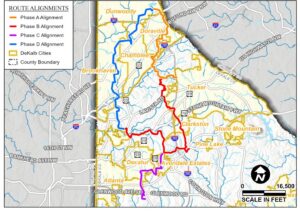
Determining the alignment required two large-scale infrastructure routing studies and coordination with multiple agencies. A joint venture of Freese and Nichols and Graham & Associates Inc. worked with the county’s Department of Watershed Management to determine the best routing options for the first two of four planned phases of the pipeline project.
Using strategies including an artificial intelligence-powered utility mapping tool, early identification of critical easements needs, data-driven material selection, and coordination with other capital improvement projects, the team saved the county on costs, condensed the schedule significantly and reduced potential public disruptions from construction.
Josh Starling, Marco Carlomusto Orlando and Antonia Kopp from Freese and Nichols’ Transmission and Utilities group partnered with DWM’s Alia Johnson, engineering manager, and Arjen Bootsma, a principal engineer/project manager, to tell the project story in the July/August issue of Civil Engineering magazine, published by the American Society of Civil Engineers.
The authors write:
As the county’s service area has expanded and demands on its infrastructure have intensified, the need for a resilient, high-capacity water transmission system has become increasingly urgent.
To address these challenges, DWM has launched the $4.2 billion Water and Sewer Capital Improvement Program, or CIP, that includes the planning, design, and construction of new and upgraded water and wastewater assets. Central to this effort is the creation of an approximately 50 mi long 60 in. diameter transmission main loop — a critical infrastructure backbone intended to improve long-term system reliability, operational flexibility, and service capacity.
The article explains the process for evaluating three alignment alternatives based on 10 weighted criteria, including constructability, construction cost, utility congestion, transportation and environmental impacts, and easement acquisition requirements.
The team also describes how they achieved savings and efficiencies such as these:
- Applying 4M Analytics’ AI utility mapping platform instead of traditional subsurface utility investigation for a comprehensive depiction of utility congestion and conflicts, saving an estimated $140,000 and reducing the schedule by more than eight weeks.
- Using GIS analysis and field reconnaissance to pinpoint parcels where easements would be needed, including a movie theater property at a major crossing, so the county could start working on that aspect early and minimize schedule delays and legal risks.
- Coordinating with projects in DWM’s broader capital improvement strategy to help reduce redundant construction and conflicts. For example, consolidating construction of the second phase of the pipeline with replacement of a parallel section of other transmission mains will save an estimated $42 million in future costs and reduce public disruption.
Read “A new transmission line will loop through Metro Atlanta’s dense environment”
The authors will present on the project Aug. 5 at ASCE’s Utility Engineering & Surveying Institute (UESI) Pipelines 2026 Conference in Detroit.