

Lockhart Plans for a More Resilient Future
The Lockhart Comprehensive Plan project won a 2026 Vernon Deines Merit Award for Outstanding Small Town or Rural Plan (Small Jurisdiction) from the American Planning Association’s Small Town and Rural Planning Division (STaR) and a 2025 Texas Planning Award in the Resilience category from the Texas Chapter of the American Planning Association (APA).
Lockhart’s award-winning Comprehensive Plan is being recognized on the national stage as a blueprint for small-town planning excellence. By earning the 2026 Vernon Deines Merit Award, the City joins an elite group of communities whose plans demonstrate outstanding vision, innovation and lasting impact. The award honors comprehensive plans that not only chart a course for future growth but also inspire meaningful community engagement, foster collaboration and provide a clear path toward implementation and long-term sustainability.
Located 30 miles south of Austin, Lockhart is facing rapid regional growth that has heightened concerns about land use, housing affordability and infrastructure capacity, as well as the community’s overall resilience to future change and disruption.
Existing plans did not adequately address community-wide resilience — social, economic or environmental — instead focusing primarily on physical infrastructure improvements. Lockhart sought to develop a comprehensive plan that not only consolidated and updated existing plans but also took a holistic approach to better prepare its community to withstand unexpected disasters or stressors.
The City partnered with Freese and Nichols’ Urban Planning + Design team to create the Lockhart Looking Forward Comprehensive Plan, a resilience-focused roadmap integrating hazard mitigation and community well-being.
Building Resilience from the Ground Up
Resilience is a foundational theme embedded in every chapter of the plan — land use, housing, mobility, infrastructure and economic development. This is reflected in both physical infrastructure and community systems, such as:
-
Resilience hubs: Community spaces that serve everyday needs but can pivot to provide shelter, information and resources during disasters, each tailored to neighborhood-specific vulnerabilities to allow for culturally appropriate, localized preparedness and response
-
Community completeness: Creation of well-rounded districts that offer diverse housing, convenient access to jobs and services, multiple mobility options, and public spaces — reducing travel needs and strengthening local connections
-
Structural improvements: Adoption of stricter floodplain regulations using FEMA’s base-level engineering data and implementing the latest building codes to mitigate physical vulnerabilities
-
Water improvements: Specific recommendations related to water auditing, water quality, innovative stormwater management and a One Water approach
-
Hyperlocal engagement: Including year-round education campaigns, evacuation route outreach and promotion of programs for marginalized communities

Putting Community at the Center
It was imperative to the City to engage a wide spectrum of voices from the community to build trust and buy-in, especially among residents who have shown resistance to planning and growth.
The City began by forming a steering committee representing City Council, the school district, local business and nonprofit leaders and culturally diverse organizations, such as the Greater Caldwell County Hispanic Chamber of Commerce.
In addition to citywide surveys, Lockhart launched an interactive project website that expanded equitable participation through language translation, mobile-friendly tools and geo-tagged comment mapping, ensuring residents could share feedback easily from any device. Together with this digital outreach, Lockhart hosted several public events designed to reach residents in accessible and engaging ways.
A particularly successful effort was a hands-on public land use workshop that used LEGOs and a scaled city map to help neighbors collaborate on community issues, design their own land use plans, and explore the trade-offs involved in their decisions. The event created valuable two-way learning; participants gained insight into the complexities of planning, while the planning team gained a firsthand understanding of community priorities.
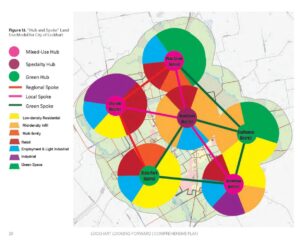
Insights from the workshop informed a series of growth scenarios that the steering committee refined into the final “hub and spoke” land use model, which anchors districts around mixed-use nodes to increase access to jobs, goods and services across the city.
Turning Planning into Lasting Impact

The insights gathered through the engagement efforts directly shaped the plan’s recommendations and its long-term benefits to the community, including:
-
Improved economic stability and job access through coordinated land use, transportation, and workforce initiatives — including industrial park expansion, small business support and downtown revitalization
-
Reduced disaster-related financial risks by investing in resilient infrastructure and hazard mitigation projects that decrease the potential for costly damages and disruptions
-
Fostered public awareness and promoted equitable preparedness through targeted investments in historically underserved neighborhoods
At its core, the new plan strengthened the City’s ability to adapt to and recover from disasters, transforming resilience into a proactive, communitywide effort.
Lockhart’s comprehensive plan now serves as a model for how small communities can integrate holistic resilience into everyday planning and policy decisions.