

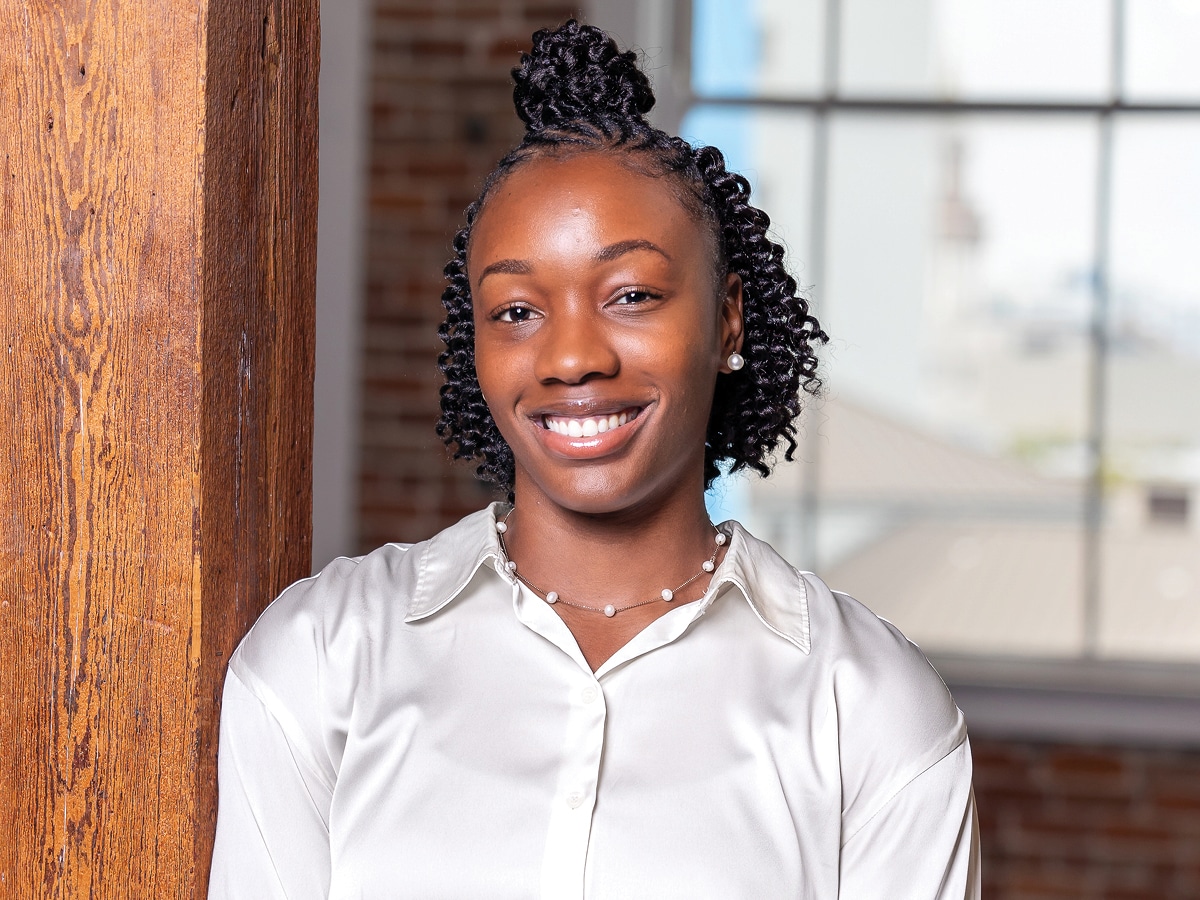
Kiara Horton, PE
Coastal & Water Resource Design Engineer
Growing up in New Orleans, Kiara Horton didn’t realize that working on challenging school projects was leading her toward an engineering career protecting the coastal areas she’s always called home. But it was fortuitous that while she was attending the University of New Orleans, Freese and Nichols opened an office in her hometown.
Kiara joined the New Orleans office as an intern in 2020 then moved into a full-time position after graduating. Working on coastal restoration projects, she’s helping shape a resilient future for vulnerable areas — and she’s sharing her growing expertise, mentoring to younger coastal engineers.
Proximity to the coast is not what makes her team “coastal,” Kiara explained. Their work brings together many skills that go into protecting coastal regions: structural expertise, geotechnical analysis of soils and foundations, ocean engineering and water/stormwater modeling to help reduce flood risk.
“Coastal is a conglomerate of all the engineering disciplines,” Kiara said. “We are the first line of defense for a lot of cities. Most places in our country are along the coast, so if we aren’t protecting the coast, everything that we love about where we live is vulnerable.”
Kiara has supported many different projects involving planning, permitting and design. She’s continued to build skills using software tools such as HEC-RAS for modeling and GIS for mapping. She also has learned to create designs for relocating underwater soil to a construction site (dredge borrow) and transporting fluids from one location to another (conveyance).
While gaining hands-on experience, Kiara has continued her education, receiving a master’s degree from the University of New Orleans in 2025 and graduate certificates in Coastal Engineering and Coastal Sciences.
She’s busy on many levels, helping recruit new engineers to the firm, presenting her technical work at national coastal conferences and mentoring engineers in training in the New Orleans office. She also volunteers with professional groups such as the American Society of Civil Engineers and Society of American Military Engineers and at community improvement activities. For instance, she’s a regular at events to clean up litter and to improve the Louisiana coastline by recycling Christmas trees and oyster shells.
“Kiara has matured into an amazing young engineer, not afraid of being confronted with new projects and challenges, learning new skills and conduct necessary research to find the solutions for unique coastal problems,” said Nina Reins, a senior coastal engineer/associate, who opened the New Orleans office and help bring Kiara on board.
“She is trained to collaborate with coastal scientists, stormwater engineers, urban planners and landscape architects as well as environmental scientists as needed to solve our clients’ problems and foster coastal resilience.”
Explore more about Kiara’s journey.
Why is it important to you to improve and protect coastal areas?
“I’m from New Orleans, and you hear about a lot of folks not wanting to move here because they think we’re going to sink in this lifetime, more or less. I know I can’t reverse the damages that have already been done, but I can at least mitigate by all the things that I’ve learned in school and with other engineers.
“I feel it’s a duty of mine. I live here. This is my home. I want to protect it with whatever I can.”
(On one project, she helped streamline data analysis on stormwater models to better understand how nature-based solutions could improve drainage in a flood-prone neighborhood where she was living at the time. Her familiarity with the area and its needs helped her connect with residents at public meetings.)
What initially led you into your field of work? How did you learn about Freese and Nichols?
“I went to a STEM middle and high school, and I was always pretty good at math, so it seemed like a perfect fit. We had large endeavor projects each year, and unbeknownst to me at the time, I was choosing topics that screamed engineering and screamed civil and coastal restoration.
“By the time I got to my junior and senior year, the teacher who I considered to be my mentor told me I’d been doing civil engineering this whole time. That’s when those two things clicked for me, so once I graduated high school I went to college to pursue that.
“When I was a junior at the University of New Orleans, I met Nina Reins, and she had just opened the New Orleans office. During that point, I was interning with another firm, and I was doing transportation engineering work, which was not my desire. When Nina came along and presented what she was trying to do with New Orleans, it was kind of a no-brainer. It was a perfect learning opportunity for me just to see everything that a coastal engineer can do from conception of a project to planning, designing and receiving funding.”

You were one of the youngest coastal engineers at Freese and Nichols when you started. What was that experience like?
“Because my undergrad was just in general civil engineering, coming into the coastal world was a learning curve since I didn’t have that foundation coming in. I was allowed to take trainings that have helped me with my modeling skill set, fundamentals of wave modeling and wave theory, and I was able to pursue my master’s degree as well. All of these opportunities encouraged me and supported me.”
As you have started to teach and mentor other young engineers on the coastal team, how do you approach growing the team?
“It’s a pretty surreal experience. I’m six years in, but sometimes I still feel very fresh to the field considering that a lot of more senior folks in the New Orleans office have been here for upwards of 20 years already. While it feels like I don’t have all the experience, the juniors still look up to me, and I’m able to impart what I do know. It’s a good feeling to still not know it all but know enough to be able to pass on some knowledge.”